
Should You Buy Travel Insurance for Your Jamaica Villa Vacation?
What every traveler should know before booking a private villa
The whole family has finally agreed on dates that work.
The flights are booked.
You’ve found the perfect villa.
You’ve paid your deposit, started planning excursions, and can already picture everyone gathered around the table for dinner in Jamaica.
Then life happens.
A family member becomes ill.
A severe storm disrupts flights.
A work emergency changes your plans.
Or something completely unexpected turns your vacation upside down.
When you’re investing thousands of dollars in an international vacation, travel insurance may be one of the most important purchases you make.
Or it may be something you, hopefully, never use.
The question isn’t whether everyone should buy travel insurance. The question is whether you understand the financial risks if you choose not to.
After welcoming guests to Jamaica for more than 25 years, we’ve seen firsthand how quickly even the best-planned vacations can change. We’ve also learned that many travelers don’t fully understand how travel insurance works or why it can be especially important when renting a private villa.
This guide is designed to help you make an informed decision.
A Vacation We Almost Didn’t Take
Several years ago, my family planned what had been a long-awaited trip to South Africa.
Our itinerary required connections through Atlanta and Amsterdam before arriving in Cape Town.
The first flight was delayed because of mechanical problems.
That single delay meant we would miss our international connection.
The airline’s proposed solution?
Spend nearly two unexpected days in Amsterdam waiting for another flight or postpone the beginning of our vacation.
Neither option took into account the hotel reservations we had already paid for, the activities we had booked, or the vacation time we had carefully planned months in advance.
Fortunately, after speaking with a supervisor and thanks to our frequent flyer status, we were able to catch another flight and continue our journey.
We were lucky.
Many travelers are not.
That experience reminded us how quickly circumstances beyond your control can affect an entire vacation.
Then COVID Changed the Travel Industry Forever
The COVID-19 pandemic reminded travelers and accommodation owners alike that unexpected events can affect an entire industry overnight.
Many travelers lost money on vacations they could no longer take.
At the same time, hotels, airlines, tour operators, and villa owners experienced widespread cancellations while continuing to pay mortgages, insurance, utilities, maintenance costs, and employee wages.
Neither side expected it.
COVID also taught another important lesson.
Travel insurance is not a guarantee that every cancellation will be reimbursed.
Coverage depends on the specific policy, the reason for cancellation, and often when the policy was purchased.
Some travelers were protected.
Others discovered too late that their particular situation wasn’t covered.
The lesson isn’t simply to buy travel insurance.
The lesson is to understand exactly what your policy covers before you need it.
Why Travel Insurance Can Be Especially Important for Villa Vacations
One of the biggest differences between booking a hotel and booking a private villa is something many first-time villa guests don’t realize.
When you reserve a hotel room, you’re booking one room from a property that may have hundreds.
When you reserve a private villa, you’re reserving the owner’s entire inventory.
There isn’t another room to sell.
There isn’t another identical villa waiting in the wings.
Those dates are reserved exclusively for your family.
That means you’re paying for more than the nights you’ll actually spend at the villa.
You’re paying for those dates to be held exclusively for your group from the moment your reservation is confirmed.
Behind the scenes, the property continues to be maintained whether you’re there or not. The pool is cleaned, the gardens are cared for, utilities remain connected, insurance is maintained, routine maintenance continues, and the villa is kept in the condition you expect when you arrive. Staff schedules are planned and preparations begin well before check-in.
This is one of the fundamental differences between reserving a private villa and booking a hotel room.
You’re purchasing exclusive availability, not simply occupancy.
Because there is only one property to rent, villa cancellation policies are often different from hotel cancellation policies.
A Real-Life Example
Several years ago, someone we know reserved a villa in Jamaica months in advance.
A few months before the trip, she accepted a new job.
She later decided she wasn’t comfortable taking vacation so soon after starting her position.
She canceled her reservation less than 60 days before arrival.
She was understandably disappointed when she lost her deposit.
From her perspective, she had a perfectly reasonable reason for canceling.
And she did.
Unfortunately, a vacation rental agreement is a legal contract.
The villa had been reserved exclusively for her group, and other guests had been turned away for those dates.
Neither side had done anything wrong.
Life had simply changed.
Situations like this are exactly why many travelers choose to purchase travel insurance.
Travel Insurance Is Not Just About Canceling Your Trip
One point that often causes confusion is that trip cancellation coverage and travel medical coverage are not the same thing.
Many travel insurance plans include both, but not all do. Some policies focus primarily on protecting the money you’ve invested in your trip, while others are designed mainly to cover medical expenses if you become ill or injured while traveling internationally. Some travelers even purchase these types of coverage separately.
Before purchasing a policy, take a few minutes to understand exactly what it includes.
What Does Travel Insurance Typically Cover?
Coverage That May Protect Your Vacation Investment
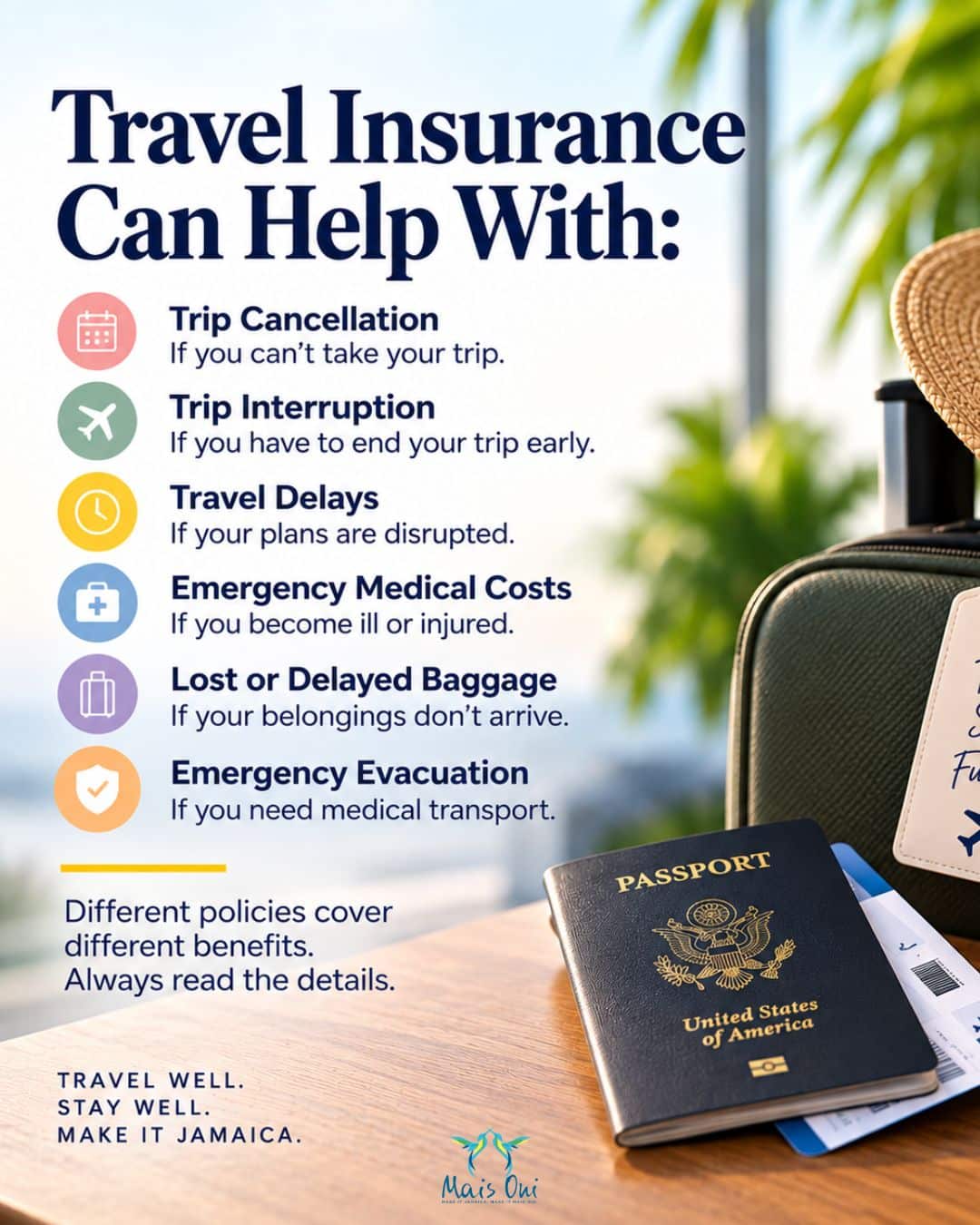
Every policy is different, so always read the details carefully before purchasing. Depending on the plan you choose, travel insurance may include some or all of the following.
Trip Cancellation
May reimburse eligible prepaid, non-refundable travel expenses if you must cancel before departure for a covered reason.
Trip Interruption
May reimburse unused prepaid travel expenses if you have to end your vacation early because of a covered event.
Travel Delay
Can help cover reasonable expenses such as meals, accommodations, and transportation if your trip is significantly delayed.
Lost, Stolen, or Delayed Baggage
Depending on the policy, coverage may reimburse you for essential purchases if your luggage is delayed or compensate you if your belongings are lost or stolen.
Coverage That May Protect Your Health While Traveling
Emergency Medical Expenses
If you’re traveling internationally, don’t assume your regular health insurance will provide the same coverage it does at home.
Many U.S. health insurance plans offer limited or no coverage outside the United States.
Likewise, Medicare generally does not cover healthcare outside the U.S., except in very limited circumstances.
Before traveling internationally, review your existing health insurance benefits and determine whether additional travel medical coverage makes sense for your situation.
Emergency Medical Evacuation
If adequate medical care isn’t available nearby, this coverage may help pay the cost of transportation to an appropriate medical facility.
Medical evacuations can be extremely expensive, making this one of the most valuable benefits for some travelers.
What Is “Cancel for Any Reason” Coverage?
Some insurers offer an optional upgrade known as Cancel for Any Reason (CFAR) coverage.
Unlike standard trip cancellation insurance, this option may allow you to cancel your trip for reasons that aren’t covered under a traditional policy.
Policies vary considerably.
Some reimburse only a portion of your prepaid trip costs, and eligibility often depends on purchasing coverage within a specified period after making your initial trip payment.
If flexibility is important to you, compare policies carefully before making your decision.
When Should You Buy Travel Insurance?
If you decide travel insurance is right for you, don’t wait until the last minute.
Many policies offer additional benefits or optional upgrades only if coverage is purchased shortly after making your initial trip payment.
Waiting too long may limit your options.
Always review the policy requirements and purchase deadlines before relying on a particular benefit.
Can Villa Owners Simply Refund Everyone?
This is a question we occasionally receive.
The answer is more complicated than many people realize.
Villa owners cannot purchase insurance that reimburses them if a guest cancels because of illness, a family emergency, airline disruptions, or other personal circumstances.
Once a villa is reserved, those dates are removed from the market.
If a cancellation occurs close to arrival, there often isn’t enough time to secure another booking, particularly for larger villas that require coordinating multiple travelers, flights, and vacation schedules.
That doesn’t mean villa owners lack compassion.
It reflects the realities of operating a business with one property instead of hundreds of hotel rooms.
One purpose of travel insurance is to help protect travelers from certain unexpected events covered by the policy.
One More Option to Consider
If you book Mais Oui Villa directly through our secure online booking platform, you may be offered the opportunity to purchase optional trip cancellation protection during the booking process.
This coverage is provided by the travel protection partner integrated with our booking platform, not by Mais Oui Villa.
We do not sell travel insurance, receive commissions, or benefit financially if you choose to purchase coverage.
Whether you purchase that policy, obtain coverage through another provider, or decide not to purchase travel insurance at all is entirely your choice.
Our goal is simply to encourage every guest to understand the financial risks associated with any international vacation and make the decision that best fits their own circumstances.
Because insurance products, pricing, eligibility requirements, and coverage can change over time, always review the current policy details carefully before purchasing.

Choosing the Right Policy
Not every traveler needs the same coverage.
As you compare policies, consider:
The total value of your prepaid, non-refundable trip expenses.
Whether your health insurance provides adequate international coverage.
Your age and medical history.
Whether you’re traveling to multiple destinations.
Whether you plan to participate in adventure activities.
Whether medical evacuation coverage is important to you.
Whether additional flexibility, such as Cancel for Any Reason coverage, is worth the additional cost.
Don’t compare policies based on price alone.
Compare what they actually cover.
Frequently Asked Questions
Is travel insurance required for Jamaica?
Travel insurance is generally not required to visit Jamaica. Whether to purchase it is a personal decision based on your own comfort with financial risk.
Does Medicare cover me while traveling internationally?
Generally, no. Medicare provides very limited coverage outside the United States. Review your own healthcare coverage before traveling internationally.
Does travel insurance cover hurricanes?
It depends on the policy, the timing of your purchase, and the specific circumstances. Always read the policy carefully.
Will travel insurance reimburse my villa deposit?
If your policy includes trip cancellation coverage and you cancel for a covered reason, it may reimburse eligible non-refundable payments. Coverage varies by policy.
Does Paying with a Credit Card Automatically Protect Your Trip?
Many travelers are surprised to learn that some credit cards include travel benefits such as trip cancellation, trip interruption, travel delay, or lost baggage protection.
However, the coverage varies significantly from one card to another. Some cards provide extensive benefits, while others offer very little or none at all. In many cases, you must pay for all or most of your trip with that credit card for the benefits to apply.
Before relying on your credit card’s travel protections, contact your card issuer or review your card’s Guide to Benefits to understand exactly what is and isn’t covered. You may find that the coverage is sufficient for your needs, or you may decide that additional travel insurance is appropriate.
Is annual travel insurance worth considering?
If you travel internationally several times each year, an annual travel insurance policy may be more economical than purchasing separate policies for every trip.
Our Perspective
Travel insurance isn’t mandatory, and many travelers choose not to purchase it.
If everything goes according to plan, they may never need it.
On the other hand, if something unexpected happens and they have chosen not to purchase travel insurance, they should understand that they may be responsible for any non-refundable expenses, in accordance with the cancellation policy they agreed to when they booked.
Every traveler has to decide how much financial risk they are comfortable assuming.
There isn’t a right or wrong decision.
There is only an informed decision.
Before booking any international vacation, take the time to understand the cancellation policy, review your existing insurance coverage, and decide whether travel insurance makes sense for your circumstances.
We sincerely hope you never need it.
But if life takes an unexpected turn, you’ll be glad you took the time to understand your options before you traveled.


